

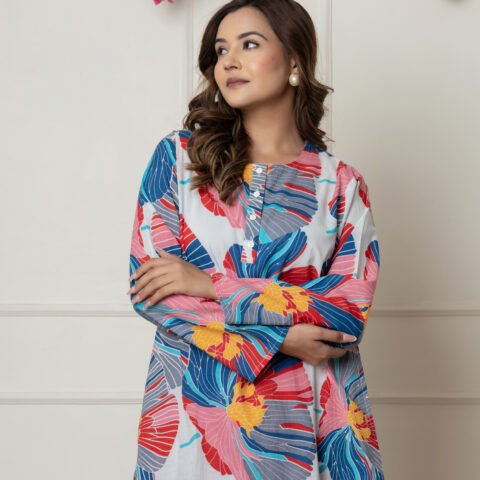
Fashionwise, Delhi is usually seen as the most influential city in India. Thanks to its dynamic marketplaces, well-known fashion hubs, and expanding network of textile companies, the city has become a cornerstone in the national garment sector. Given the many Wholesale Kurti Manufacturers in Delhi, kurtis are very important as a sign of modernism blended with heritage. They are a must-have for Indian women because of their unrivaled adaptability, which enables them to be worn for everyday wear, work clothing, and festive parties as well as other events.
Still, the kurti designers are the ones that provide the variety and grace of these garments. They are always changing the criteria of design and the quality of their created clothes. These producers not only satisfy local retail demand but also export Indian traditional apparel to many countries worldwide. Some of the most well-known kurti designers in Delhi, who are really altering the landscape of Indian fashion, are featured on this page.
The Evolution Of Delhi As A Kurtis Manufacturing Center
Delhi’s development as a major textile manufacturing center is not something that occurred over night. The city’s great tradition of workmanship, strategic position as a commercial center, and straightforward raw material availability assist to explain why it dominates the fashion industry. From the classic chikankari-inspired kurtis to the fusion clothing mixing Indian embroidery with Western styles, Delhi-based companies have pushed the boundaries in a variety of ways regarding fashion innovation.
A Workmanship Fit For Current Needs
Delhi’s kurti designers stand out from others throughout India because they can combine contemporary sensibilities with traditional handiwork. Delhi’s producers are quite adaptable unlike other regions that might concentrate on handloom or embroidery-specific methods. They meet people’s preferences all throughout India and even build concepts appealing to customers from outside.
Some Delhi design companies have added digital printing, environmentally friendly dyes, and smart sizing to meet present worldwide trends. They simultaneously maintain Indian clothing aesthetically pleasing with their patterns featuring mirror work, gota patti, and complex thread work. Thanks in great part to its all-encompassing strategy, Delhi has become a valued partner for ethnic clothing retailers not just in India but even beyond its borders.
Famous Names and Industry Leaders
Among the many gifted kurti designers, a tiny group of companies have become leaders in terms of ethical business practices, quality, and creativity. One great example of this is the Rangriti ethnic clothing company situated in Delhi, under BIBA. Rangriti is committed to keep great quality while meeting mass market needs. Young urban women in tier-1 and tier-2 cities make up the target market for their vivid kurti collections, which combine visually attractive designs with fabrics letting air circulate.
One such company that really stands out is Libas, which controls production and design from its Delhi headquarters. Thanks to Libas, known for its chic mix-wear, the younger generation now has greater opportunity to come across Indian fashion. Keeping cost in mind, their designs stand out for their modern interpretation of the traditional kurti shape, which calls for flared hems, bell sleeves, and asymmetrical cuts.
W for Woman is another company that has shown remarkable expansion over the last ten years, however it is situated in Delhi. W has helped kurtis change into more office-friendly, wardrobe-flexible clothes by using its in-house production technology and design-forward attitude. Their works emphasize the requirement of simple tailoring, basic patterns, and subdued color palettes, thereby highlighting the sensitivities of contemporary Indians.
Behind-The-Scenes: The Genius Of Small-Scale Businesses
Hundreds of small to medium-sized companies sustaining Delhi’s kurti industry include boutiques, internet stores, and private brands. Though the huge names govern retail, these businesses also inspire the Delhi kurti scene. Usually, these vendors run out of small workshops scattered around Seelampur, Okhla, and Gandhi Nagar. Among artists, they deal with seasoned embroidery, sewing, and pattern creation experts.
These tiny companies separate out from the rest as they concentrate on customizing. They can manage large orders with seasonal requirements, special material requests, accurate size charts containing expectations. Fashion startups and export businesses wishing to test new ideas without making significant expenditures might also make advantage of made-to- order alternatives offered by certain organizations.
Many times, family-owned and operated companies handed on from generation to generation are these kinds of companies. They are well aware of their own as well as of the many types of textile textures, dye behavior, and consumer trends. Their great understanding of the firm helps them to produce kurtis of extraordinary quality that satisfy both traditional design preferences and evolving demands of fashion.
Kurtis Manufacturing Under Digital Transformation
The designers of the Delhi kurtis have not stayed still in front of changing technology environment. Many have embraced utilizing digital channels for business-to–based marketing, order processing, and consumer contact. Online platforms include websites, Instagram profiles, WhatsApp catalogs, and business-to–marketplaces like IndiaMART and TradeIndia are becoming fundamental instruments for accessing their client base.
Among the many ways these businesses are modernizing their operations, some include virtual sampling, artificial intelligence-assisted fabric cutting, and online inventory management systems. To let customers all across the world access their collections, some manufacturers also take part in trade expos and fashion shows.
Moreover, the growth of direct-to– consumer (D2C) companies has given Delhi’s kurti producers a big edge. To develop their own ethnic clothing lines, many company owners are now directly dealing with these producers. Producers are therefore not just back-end suppliers but also stakeholders in the routes via which brands are created.
Environmentally Conscious and Moral Actions
Increasing numbers of contemporary kurti consumers are beginning to pay greater attention to their environment; producers from Delhi are catching up as well. Many quite profitable companies are funding environmentally friendly ideas include organic cotton as well as natural colors, natural dyes, and biodegradable packaging.
One also witnesses growing focus on work ethics. Several firms are seeking third-party certificates or non-governmental organizations (NGRs) in conjunction to verify that they are using moral employment policies. This is true as fair pay and safe working conditions are stressed more and more. Making this progress not only from the perspective of compliance but also helps to establish confidence for customers both domestically and internationally.
Kurti Manufacturers in Delhi are thus always popular for their versatility, cultural roots, and unrelenting pursuit of quality. Delhi has lots to offer everyone, whether your interests are in design seeking creative cooperation, fashionista attracted to ethnic flare, or retailer looking for dependable information sources.
Conclusion
Thanks to their rich ecosystem of big brands, small manufacturers, and talented artisans, the kurtis developed in this region represent the dynamic fashion development that has happened in India rather than just objects of fashion. As the market for Indian ethnic clothing both domestically and internationally continues expanding, the Kurti Manufacturers in Delhi will remain highly crucial in shaping trends and setting standards for many years to come.
 Admin
Admin